
We get this question a lot - but probably not the way you'd expect. It's rarely someone trying to squeeze a home machine into a busy office. More often, it's someone with a small team of four or five people asking about our commercial machines when, honestly, a decent home espresso machine would do the job for a fraction of the cost.
So rather than just pushing commercial machines, let's break down where the line actually sits - and what changes once you cross it.
When a Home Machine Makes More Sense
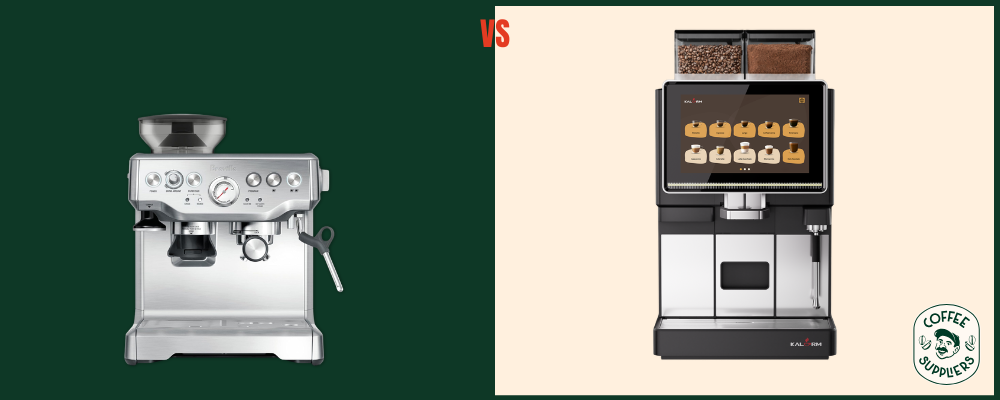
If your office has fewer than five to ten people and everyone's fairly self-sufficient in the kitchen, a home espresso machine is a perfectly good option. You can pick up a solid one for a few hundred dollars, the coffee quality can be excellent, and you're not locked into any contracts or ongoing costs beyond beans and milk.
The trade-off is that home machines are built for lighter use. They're designed to make a handful of coffees a day, not thirty or forty. The components - the grinder, the boiler, the pump - are sized and engineered for domestic duty. That's not a criticism; it's just what they're made for.
If that sounds like your situation, we'd genuinely suggest going that route. No point paying for a commercial setup you don't need.
Where Commercial Machines Earn Their Keep
Once you get past that ten-person mark, things start to change. The morning rush hits differently when fifteen people want coffee between 8:30 and 9:00. A home machine either can't keep up or starts wearing out fast because it's working well beyond what it was designed for.
Commercial machines are built for exactly this. Here's what's actually different under the hood:
Durability and build quality. Commercial machines use commercial-grade grinders, heavy-duty boilers, and reinforced internals. They're designed to run all day, every day, for years. A home machine doing the same workload will typically need replacing within 12 to 18 months.
Speed and volume. A commercial automatic coffee machine can produce a coffee in 30 to 40 seconds with consistent quality every time. Home machines are slower per cup and need more manual input - tamping, timing, milk frothing - which adds up when there's a queue.
Milk systems. This is where the gap really shows. Some home machines have steam wands, but they're typically smaller and less powerful - fine for one or two flat whites, but they struggle to produce consistent microfoam across a queue of drinks. Commercial machines step things up with more powerful steam wands for fresh milk frothing, integrated fresh milk systems that automate the process entirely, or powdered milk systems for low-maintenance convenience.
Drink variety. Most commercial machines offer a full menu at the touch of a button - flat whites, cappuccinos, long blacks, hot chocolate, and even chai lattes. That means non-coffee drinkers aren't left out, which matters when it's a shared office resource.
Plumbed water. Many commercial machines can be plumbed directly into your water supply, so there's no filling a tank every few hours. For offices making 30+ coffees a day, this alone saves a surprising amount of hassle.
The Cost Question
A good home espresso machine might cost $500 to $1,500 upfront. A commercial machine costs significantly more to buy outright - but that's not really how most offices get them.
Most workplaces either rent or get a machine on a free-on-loan basis, which means no upfront cost at all. Rental includes the machine, installation, servicing, and technical support. Free on loan works similarly but is tied to a minimum monthly spend on coffee and consumables.
When you factor in that servicing and repairs are included - and that a commercial machine will last years without needing replacement - the total cost of ownership often works out lower than cycling through home machines that weren't built for the workload.
Servicing and Support
This is the part that tends to get overlooked. When a home machine breaks, you're either paying for repairs yourself or buying a new one. When a commercial machine supplied by a dedicated provider has an issue, a phone call gets it sorted - usually with no extra cost if servicing is part of your agreement.
We've written a full guide to keeping your office machine running smoothly if you want to know what day-to-day upkeep looks like. The short version: it's about five minutes a day, and most of our machines have auto-cleaning cycles that do the heavy lifting.
Which Size Machine for Which Office?
If you've decided a commercial machine is the right move, the next step is matching the machine to your team size. We break it down into three groups:
Small offices - the Kalerm K-Series is compact, doesn't need much bench space, and handles lighter daily volumes comfortably.
Medium offices - the Kalerm O-Series steps up the capacity and adds a steam wand for fresh milk frothing, including alternative milks like oat and soy.
Larger offices - the Kalerm Y-Series handles high daily throughput with fresh milk at scale, built for teams that go through serious volume.
For larger workplaces, it's also worth considering multiple smaller machines across different floors or break areas rather than one large unit. It reduces bottlenecks, gives people options closer to their desks, and often costs about the same.
The Quick Summary
Under five to ten people? A home machine is probably the smarter, cheaper choice. Beyond that, commercial machines are purpose-built for the job - they last longer, handle volume, offer more drink options, and come with servicing and support that takes the hassle off your plate.
Not sure where your office sits? Take our 60-second Machine Quiz and we'll point you in the right direction.